Language

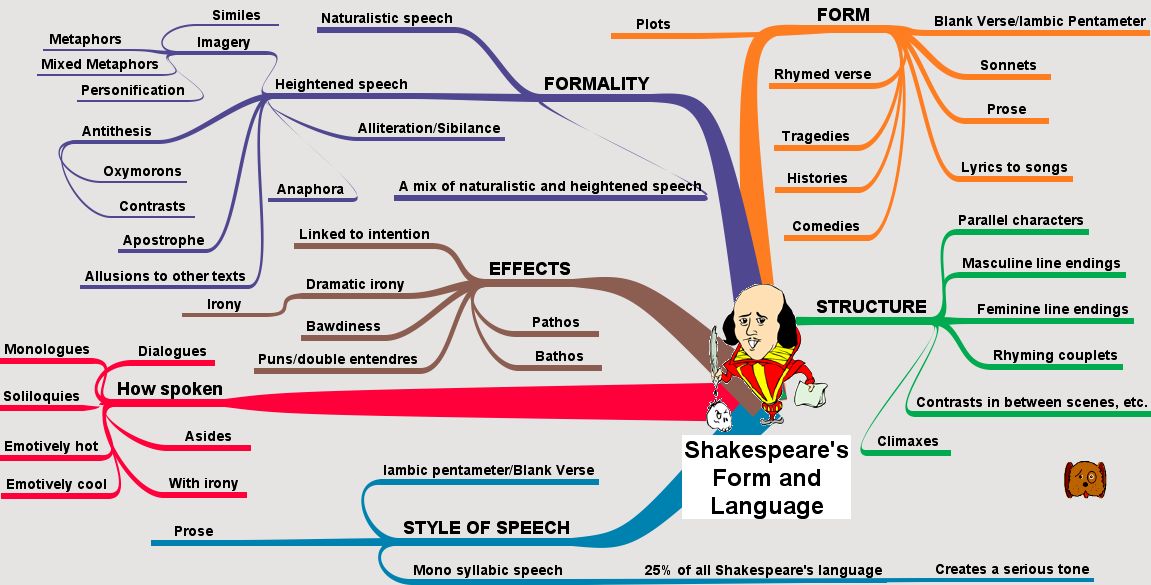
Map of Shalespearean Language. 

What is language? 

 A characteristic style of speech or writing

Act I, Scene ii

"Hamlet:  Seems, madam! nay it is; I know not 'seems.'

'Tis not alone my inky cloak, good mother,

Nor customary suits of solemn black,

Nor windy suspiration of forced breath,

No, nor the fruitful river in the eye,

Nor the dejected 'havior of the visage,

Together with all forms, moods, shapes of grief,

That can denote me truly: these indeed seem,

For they are actions that a man might play:

But I have that within which passeth show;

These but the trappings and the suits of woe."

Act I, Scene iii

"Ophelia: I shall the effect of this good lesson keep,

As watchman to my heart. But, good my brother,
Do not, as some ungracious pastors do,
Show me the steep and thorny way to heaven;
Whiles, like a puff'd and reckless libertine,
Himself the primrose path of dalliance treads,
And recks not his own rede. "
 

 In Hamlet, modern readers do not understand many of the things being said. I chose two quotes that had language attributes that relate to Shakespearean Language such as the words 'tis' and 'nay' as well as flexible syntax.

  1. Flexible syntax: Modern English uses a more rigid syntax than in Shakespeare's day: subject--verb--object with other subordinate elements scattered in so as not to disrupt the flow of these three parts of speech. Think of Yoda when reading some of Shakespeare's lines: "Sense sure you have,/ Else could you not have motion" (Hamlet 3.4.71-2).

  2. Thou/ Thee/ Hath/ Doth: Like with all of Shakespeare's language, these are purposeful choices.  In these cases, the language is elevated for formality such as when Lear tests the love of his daughters: "which of you shall we say doth love us most" (1.1.51).

  3. Anachronisms and Colloquialisms: Shakespeare used words that were already out of regular usage in his day including ycleped (called) and wight(man).

  4. Metaphors.  Much of the density and power of Shakespeare's plays comes from his powerful metaphors that are not clichés (although some of them, such as "the green-eyed monster," have become clichés): dense language is requires different reading strategies than an article in the The Chicago Tribune.

  5. Cultural Knowledge: Some language and metaphors are difficult because the cultural knowledge is no longer immediately accessible.

I got this information here.
Make a Free Website with Yola.